

In the mid-1970s university courses included content on the liberation of women, or recognizing human rights. Professor Rhoda Howard, a strong advocate of human rights, was indeed an inspiration to many in a section of sociology on women's' rights at the University of Calgary, a course I completed. Little did I know that such liberation had been occurring for hundreds of years, right on the shores of Alberta's alkali sloughs and lakes.
Named after the “Father of American Ornithology”, naturalist Alexander Wilson, Wilson's Phalaropes travel 10,000 miles from Argentina to reproduce in Canada. The energy required to make such a long journey, is acquired by stopping at salty lakes and sloughs along the way to eat brine shrimp and brine flies to “fatten up” before eggs are laid.. Inverlake Slough, just a few miles from home has been a reliable location to find these phalaropes when water levels are good. Unique amongst shorebirds, phalaropes enjoy deep water. You may see them swimming rapidly in circles, wondering if they'd lost their minds or were impaired. However there is a purpose in this swimming technique. The rapid circular swimming creates small underwater whirlpools to draw up invertebrates and aquatic insects for food.
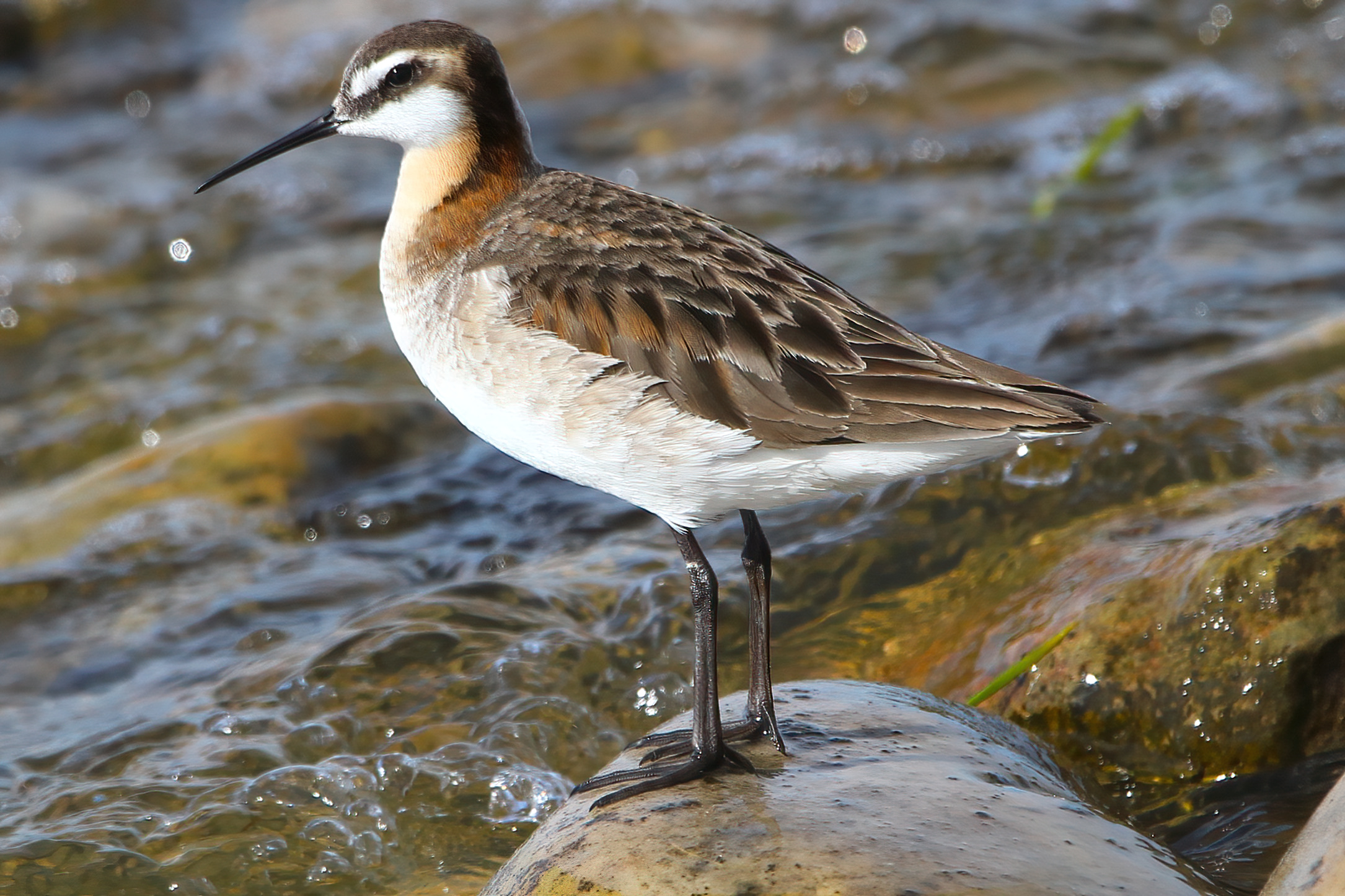
Unlike many species, where the males are brilliantly colored in order to attract mates, it is the female Wilson's Phalarope that is the beauty of the species. Breeding females sport deep hued cinnamon and rust highlights, a black stripe down the neck, blue-grey backs as well as peach colored feathers on the neck. Males share the same thin, straight bill, but have duller colored feathers and they lack the black neck stripe that helps to identify the females.
Not only more beautiful is the female but her role in a relationship is most unique. Sure, the female lays exactly four eggs, but after that contribution to the species, she has done her work. Not monogamous, the female will pursue other males after laying the eggs. She uses aggressive behaviors such as jutting her head back and forth. Once a male is picked, she will initiate the more formal courtship routine which includes bowing and notable upright postures before her union with the male. There are far more male phalaropes present, creating intense competition for attracting female attention. She has her pick in any slough!
Then the role reversal truly begins. The male phalarope will incubate the eggs for three weeks. Once hatched, the chicks keep warm by having “dad” provide the warmth as they cannot yet regulate their body temperature. A teacher as well, “dad” takes the chicks out for a foraged meal and watches out for predators. Once fledged, the chicks are on their own and the male has completed his role in propagating the species.
Having left the male behind after laying the egss, females head almost immediately south back to saline lakes such as California's Mono Lake, the Great Salt Lake and the Salton Sea. Relying on shrimp for energy, these lakes are critical for the survival of Wilson's Phalarope. Should drought such as that occurring in the Great Salt Lake continue, the most critical food supply for this bird species would disappear. It would a great loss for bird watchers to lose this “liberated” species as a result.