

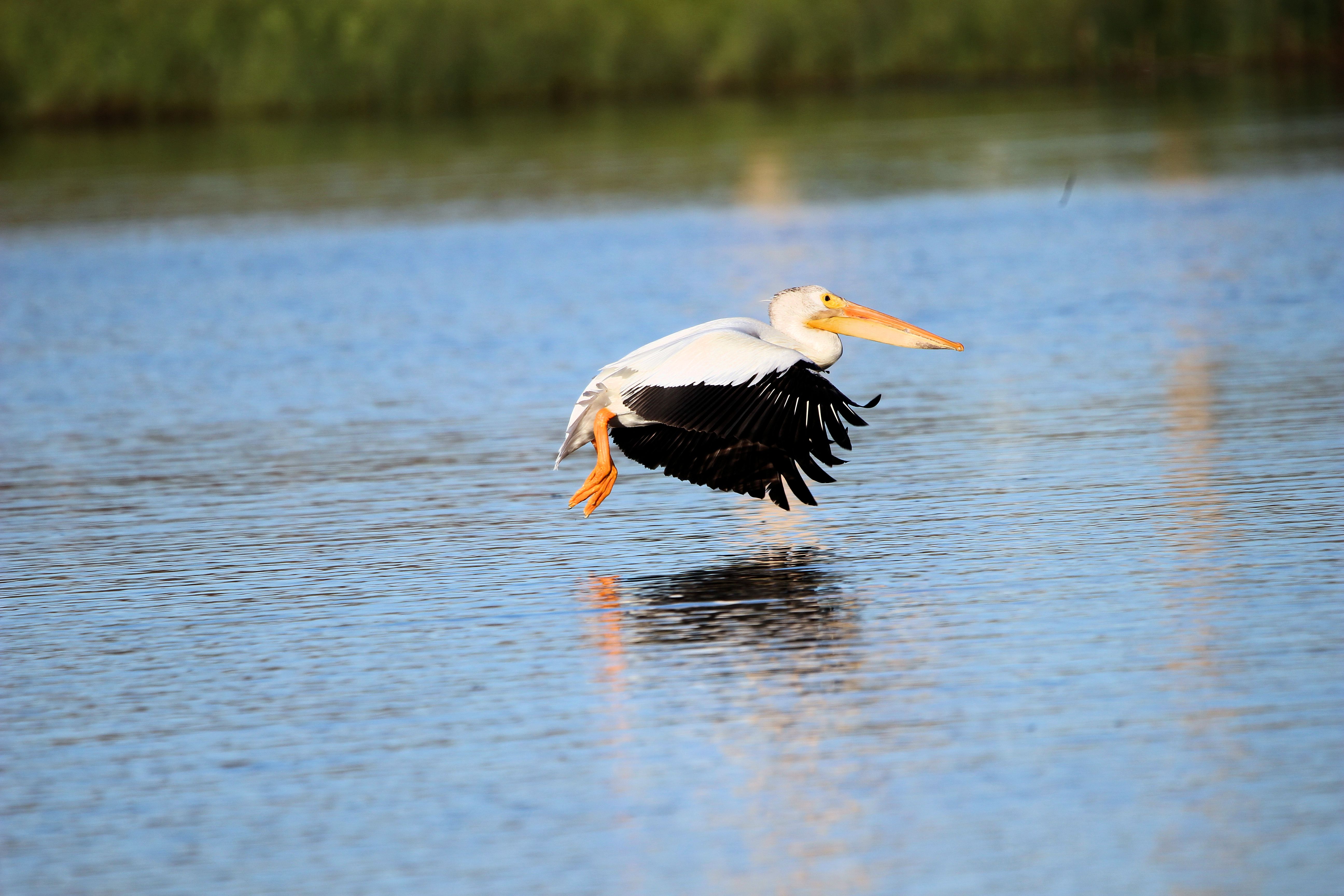
No matter how many times we see American White Pelicans, we pause for a moment to watch this massive bird, sporting a nine foot wingspan, glide seemingly endless distances to land gracefully, considering its twenty pound weight. Rarely seen alone, this community-minded bird can be seen soaring in circular patterns with fellow pelicans at incredible heights. It's a mystery to us as to why they choose altitudes at which they soar are so high. Perhaps its just the pleasure of soaring in the thermal air waves. When on the water, as we witnessed last week at Gray Park in Strathmore, another unique behavior captured our imagination.
The slough in Gray Park is shallow and is home to the invasive Prussian Carp. Great Blue Herons, Black-crowned Night Herons and pelicans are attracted to this water body, knowing that a meal likely swims below. Herons, working alone, will stand motionless and then with a lightning like stab, strike and catch a fish, quickly flipping it into a head first position, then swallow it whole. Pelicans, when focused on a meal, work in a flock with a deliberate, coordinated set of actions. We wonder if pelicans take their cues from the first of a flock that takes a specific action. However, there are some specific conditions that do work to advantage for a flock of hungry pelicans. Opportunity to catch lunch is aided by sunlight as well as the calmness and clarity of the water. No doubt, gliding lower over clear, shallow water on a windless day, gives the pelican a hunter's edge over its soon to be prey. Fish may also be near the surface or jump for a helpless insect, unwittingly revealing their location.
As white pelicans are very buoyant, they cannot dive, necessitating a species unique approach to fill the breakfast table. Starting often in a line in the shallows, pelicans will beat their large webbed feet, working to corral fish into an ever shrinking area. The formation changes from line to circle in a gradual process. The noose is then tightened, with the feet continuing to frighten any soon to be unfortunate fish. The moment of truth has arrived for the trapped fish when in a synchronized movement, every pelican dips its gargantuan bill into the water, scooping up any fish present. Once breakfast is trapped in its bill, a pelican will tilt its head, compressing muscles in order to drain out the water in its bill before swallowing the catch whole.
From the forested point across from the beach in French Bay, to the back eddies of the Bow River and on sloughs like the one at Gray Park, we relish the moments and motions of these pack hunting pelicans. We marvel at the intelligence of pelicans to work together for a common necessity where the chances of cooperative based success is more likely. I can only imagine what our world would be like, if people and nations were truly cooperative. The magic of the circle cannot be denied.