

As October slips away, the later Arctic migrating birds make their way south to wintering grounds. American Tree Sparrows make southeastern Alberta and the northern United States home for the colder months. Another migrant, the Snow Bunting leaves its Arctic nesting grounds to overwinter across several provinces. It’s this time of year when we keep both eyes and ears honed for the bunting.
With the third week of October on the horizon, a trip out to the north end of Dalmead Lake, southeast of Langdon, for a bird walk was on the menu. It’s quiet out on the elevated gravel berm and road that forms the shape of the lake. The water level is low, revealing its hidden islands and long mud caked spits that jut out into the water. A strong south wind lifts the water into active waves, lapping the rock covered north shore. As we walk west, slowly scanning the water’s edge, we spot movement. Birds! What are they? Initially thoughts of the American Pipit come to mind. Upon closer examination we have our first look at Snow Buntings for the year.
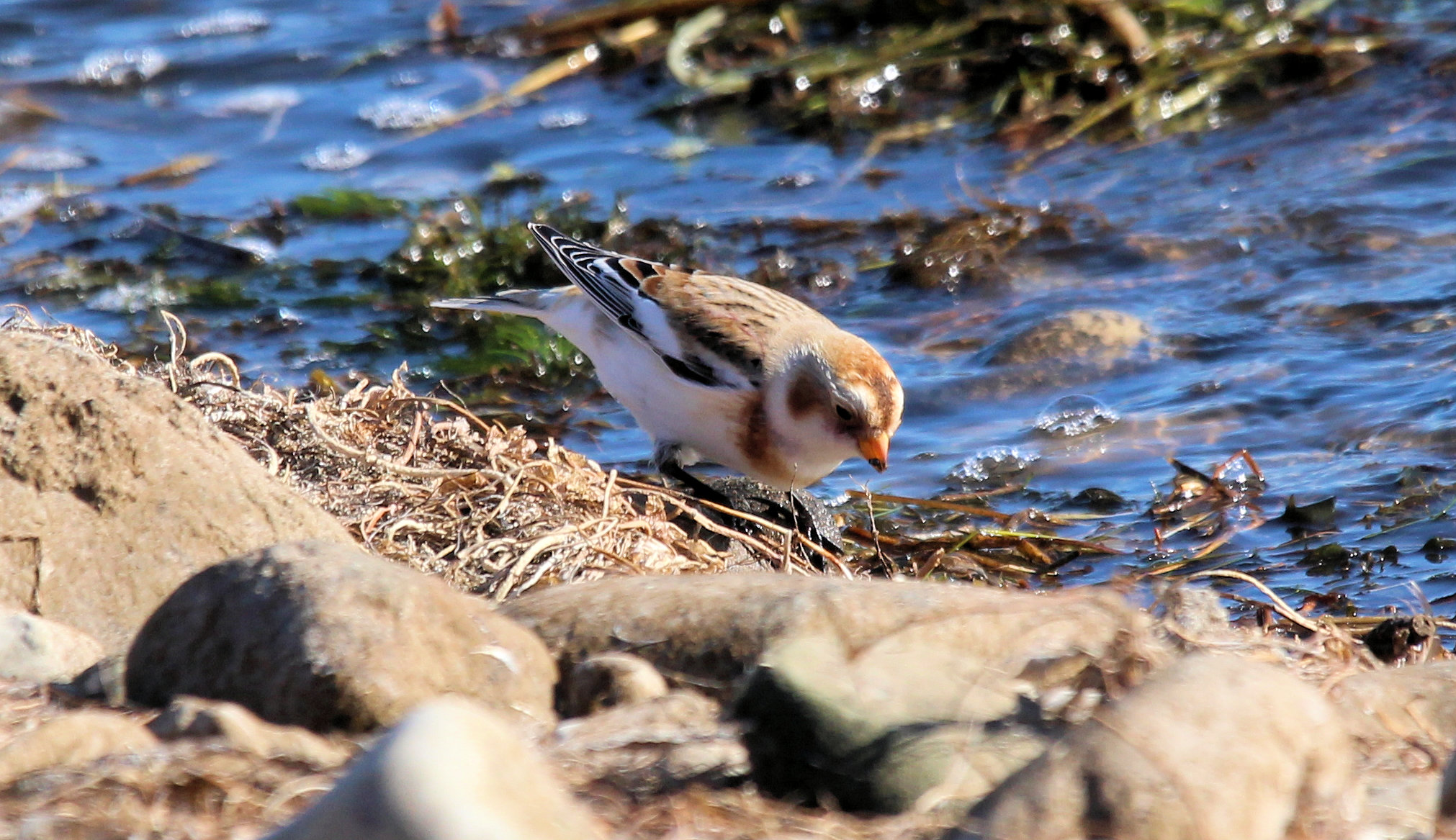
With buntings as nesters in the rocky crevices of the Arctic, the stony shores of Dalmead Lake must remind them of their summer home. A dozen buntings, incredibly camouflaged with a mix of white and rusty hued feathers are busy foraging in the rocks at the lake edge. Each wave may being with it, seeds and insects. Crouching down while searching for nutrition, the buntings blend in even more, seeming to disappear into the rocky underworld.
Having not had the pleasure of visiting the Arctic nesting grounds, the feather colors we see of the bunting are its non-breeding cover. Non-breeding males have white bellies, highlighted with rust colored patches on the crown, shoulders and notably, the “ear”. The bills of both sexes change color from a near black to an orange-yellow in the non-breeding months. Female buntings undergo a less dramatic color shift, adding rust colored patches on the face and chest in the fall. During mating season, male buntings are pure white with a black back.
As we photograph the buntings, the small flock takes flight along the shoreline every few minutes emitting short, alarm-like calls on takeoff. Landing on or between the rocks, they briefly disappear from view, hidden within the landscape.
The arrival of the buntings reminds us that we are about to experience a changing of seasons. Their white feathers hint of the snowfalls to come. I imagine the feel of the cold north winds sweeping over an ice covered lake, with lone grasses leaning and dancing in those chilling winds. Although it seems that Dalmead Lake is a quiet and lifeless space, look closely. Perhaps that flock of Snow Buntings, will reveal itself to you.