


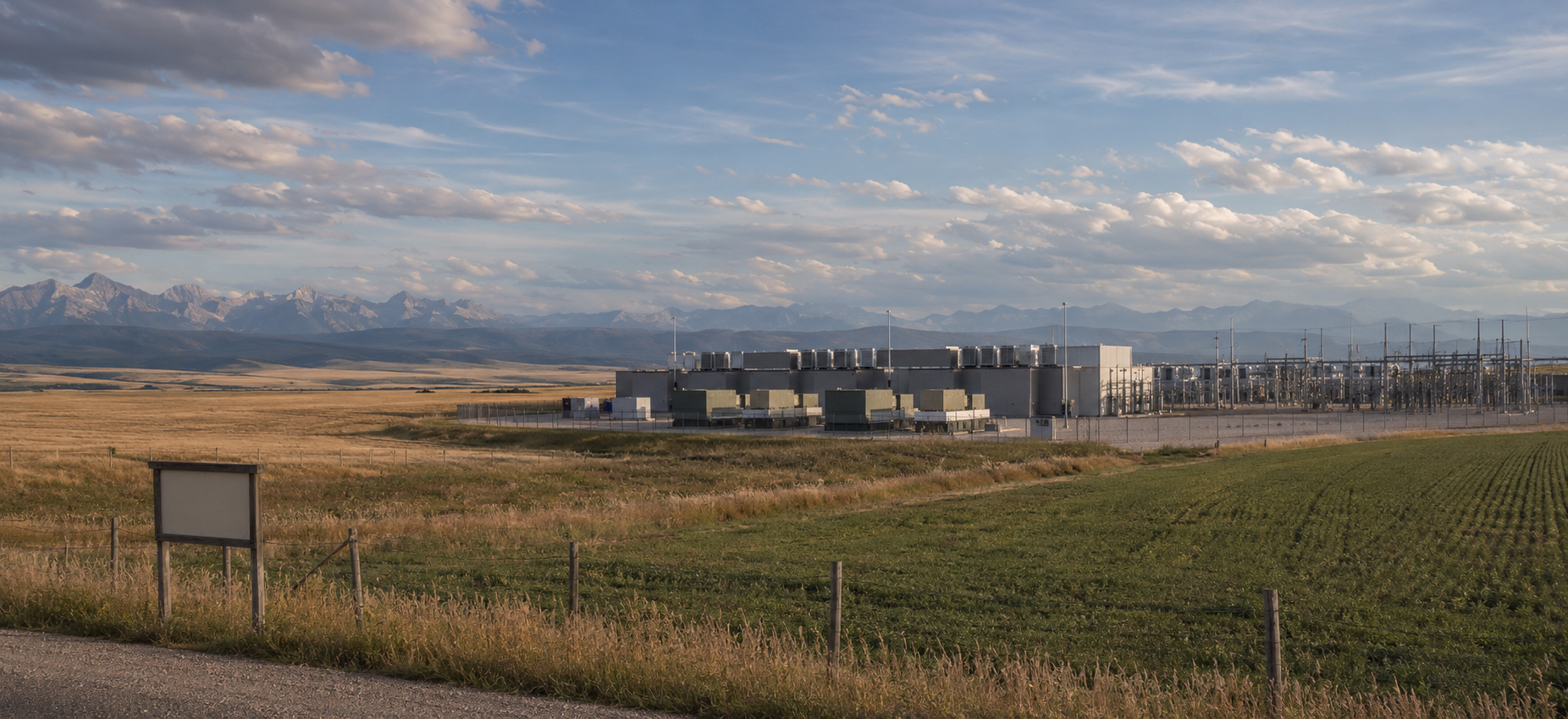
Rocky View County has strengthened its oversight of proposed data centre campuses and temporarily paused decisions on applications seeking to redesignate additional land for such developments.
Council approved Bylaw C-8766-2026 on July 21 following a public hearing that drew residents concerned about the growing number and potential scale of data centre proposals in the county.
The bylaw changes a Data Centre Campus from a permitted use to a discretionary use within the Special, Data Centre District, commonly identified as S-DAT. Under a permitted-use designation, an application that meets the applicable requirements generally must be approved. The discretionary designation gives the development authority greater latitude to assess a proposal and refuse a development permit based on its merits, planning considerations and potential community impacts.
Council also designated itself as the development authority for discretionary uses in the S-DAT District. That means elected councillors, rather than county administration, will decide development permit applications falling under the new designation.
The third amendment clarifies what kinds of power generation may be considered part of a Data Centre Campus. The updated definition includes facilities used solely to provide backup power. Utility-scale natural gas plants intended to supply a centre’s regular operating needs remain a separate defined land use and would be subject to their own approval requirements.
Following the bylaw vote, council directed administration to temporarily stop bringing forward applications to redesignate land as S-DAT. The moratorium will remain in place until the county completes its Emerging Sector Strategy and council approves a resulting regulatory framework. No end date has been announced.
The strategy is intended to help Rocky View respond to rapidly developing industries, initially focusing on technology and energy as well as tourism and hospitality. For technology-related development, the county is studying suitable locations, infrastructure and servicing limitations, effects on agricultural and residential areas, planning approval processes and opportunities for public participation.
Residents who addressed council during the public hearing raised concerns about water consumption, electricity requirements, noise, agricultural land, community character and possible environmental and health effects. Some speakers supported the bylaw amendments as a necessary first step toward stronger oversight but said the county should adopt broader protections before allowing further projects to proceed.
The county has previously said residents also raised data centre concerns during engagement related to the Wild Rose Power Hub and the Langdon Servicing Technical Review Committee. Some associated power-generation proposals may require decisions from the Alberta Utilities Commission, which has authority over matters outside the county’s municipal planning jurisdiction.
Council’s decision does not prohibit data centres or cancel proposals already moving through separate approval processes. It does, however, give council greater control when considering development permits within the existing S-DAT District and pauses additional S-DAT redesignation decisions while longer-term rules are prepared.
For residents, the practical result is an added level of public and political scrutiny before more land is designated or new discretionary permits are approved. Future applicants will face a process in which council can weigh technical evidence against documented effects on surrounding communities.