

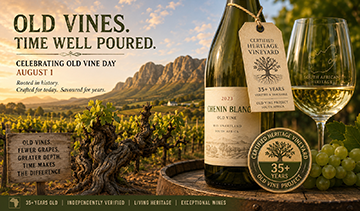
I was wandering the aisles of my friendly neighbourhood bottle shop over the weekend, when I noticed a small tag hanging from the neck of one of the bottles proclaiming the bottle came from a Certified Heritage Vineyard, whatever that may be.
Over the course of my long imbibing career, I have squandered much time deciphering wine labels to impress my regular tippling crew with obscure winery minutia, so a new bit of trivia like this immediate piqued my interest.
The bottle in question was a South African Chenin Blanc, and the tag was there to recognize Old Vine Day, celebrated every August 1 by the South African wine industry, and increasingly around the world.
Unlike so many of the wine-related holidays invented by marketeers to move their wares, Old Vine Day celebrates something more noble and worthy, namely vineyards that have survived for decades and continue producing remarkable wines.
In South Africa, a vineyard officially qualifies as an old vine once it reaches 35 years of age. That may not sound especially ancient, but in commercial viticulture it is quite an accomplishment.
Here in Canada, our chilly winters shorten vine lifespans, so the vineyard managers of the Okanagan Valley or Niagara Peninsula typically start replanting after 20 years, with only a few vines making it all the way to 35. Old World growers like France with milder winters often get 30-50 years from a vine, with the most premium regions boasting vines more than a century old, but those are very much in the minority.
Most modern vineyards are often replanted after only 20 to 30 years as yields begin to decline. While younger vines generally produce more grapes, older vines tend to produce fewer bunches, concentrating the flavours into smaller harvests that many winemakers believe result in more complex and expressive wines.
The driving force behind the Old Vine Project, founded in 2016 by renowned South African viticulturist Rosa Kruger. Long before the organization officially existed, Kruger had spent years travelling throughout the Cape Winelands identifying and documenting historic vineyards that were quietly disappearing as growers replaced them with younger, higher-yielding plantings.
Rather than allowing these living pieces of agricultural history to vanish, the Old Vine Project encourages growers to preserve them by highlighting both their historical significance and their commercial value.
One of the project's greatest successes has been the introduction of the Certified Heritage Vineyard seal, which was the bottle tag that originally caught my eye while browsing at my local wine shop. Unlike the rather vague "old vine" claims that occasionally appear on wine labels elsewhere in the world, South Africa's certification is independently verified. Every bottle carrying the seal can be traced back to a vineyard that is at least 35 years old, with the planting date confirmed through official vineyard records.
That level of traceability has made South Africa something of a world leader in recognizing heritage vineyards, and the concept has begun attracting international attention from other wine-producing countries.
Of course, old vines are not unique to South Africa. Europe is home to vineyards that have been producing grapes for generations. Faithful readers may recall me waxing poetic about a visit to the Greek island of Santorini many years ago, a unique wine region that boasts centuries-old grapevine root systems. Rather than pulling out exhausted vines, growers simply graft new shoots onto the ancient rootstock, allowing the same underground root network to continue producing grapes decade after decade. Those deep roots reach far into the volcanic soils in search of moisture and minerals, producing wines with remarkable concentration and character.
South Africa's old vineyards tell a similarly compelling story. Many were planted during the 1960s and 1970s, long before anyone imagined they would become valuable historical assets. Today these mature vineyards produce some of the country's finest examples of Chenin Blanc, Cinsault, Semillon and even Pinotage, each bottle representing decades of careful stewardship by generations of growers.
Perhaps my favourite aspect of the Old Vine Project is that it recognizes wine as more than simply an agricultural commodity. Every old vineyard has survived droughts, changing fashions, economic downturns and the occasional misguided vineyard consultant convinced that ripping everything out and starting over was the sensible solution.
So this August 1, raise a glass in honour of Old Vine Day. Browse the South Africa aisle of your neighbourhood wine merchant, and look for a bottle displaying the Certified Heritage Vineyard seal.
I like to compare the Old Vine bottle with a younger example of the same grape to see how those long years of patient vine-growing improves the wine. After all, like many of us, some things simply get better with age.