

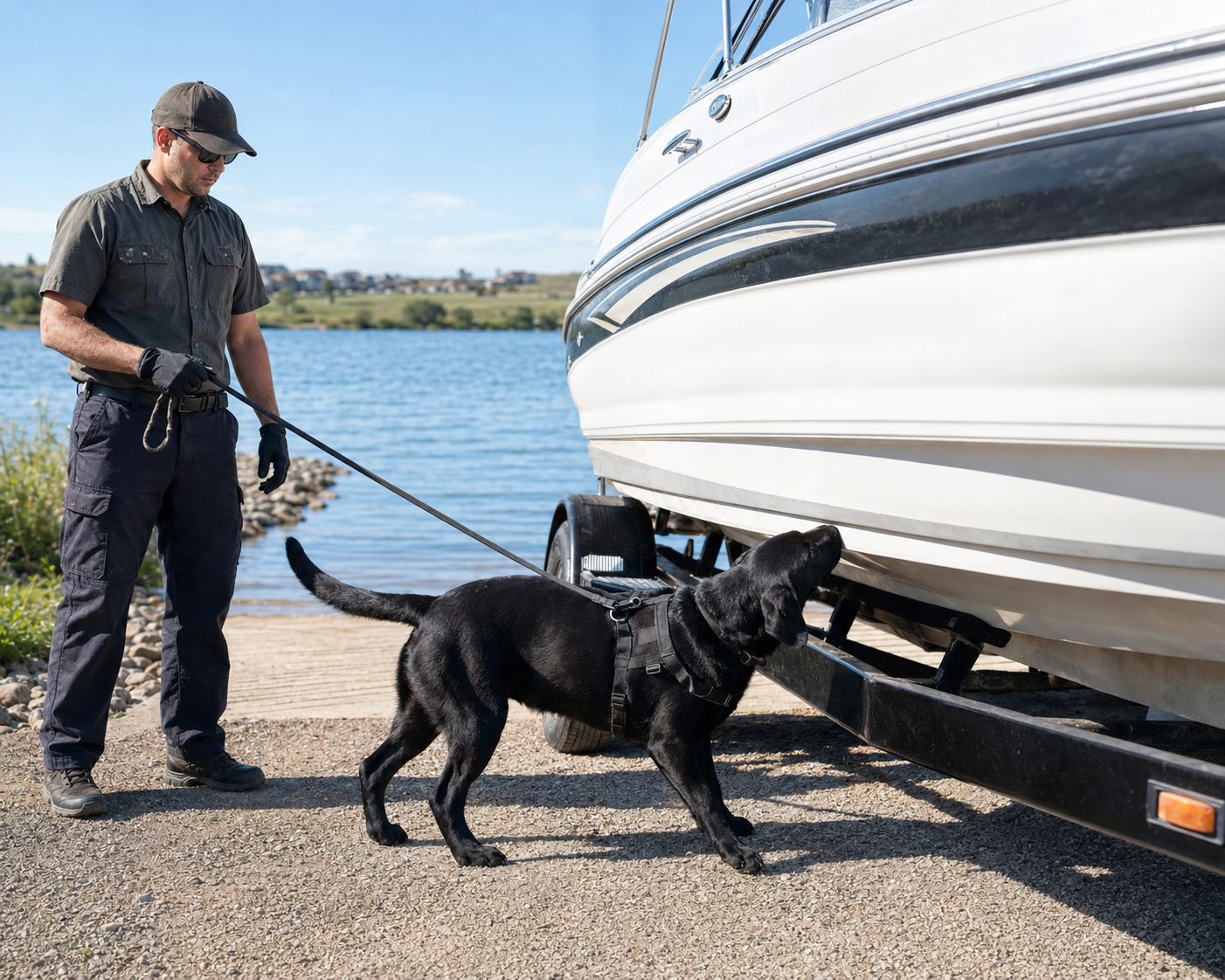
Two newly trained detection dogs have joined Alberta’s efforts to prevent invasive mussels from reaching the province’s lakes and waterways—a concern with particular relevance for recreational communities such as Chestermere.
Jane, a black Labrador retriever, and Winnie, a former shelter dog from Kansas, have joined Hilo, Alberta’s veteran conservation dog. Working with provincial watercraft inspectors, the dogs use their sense of smell to detect invasive mussels hidden in boats, trailers and equipment.
The dogs can identify zebra, quagga and golden mussels, the three invasive freshwater mussel species currently known in North America. They may also be deployed to inspect shorelines, docks, boat launches and water infrastructure.
Alberta remains free of established invasive mussel populations, according to the provincial government. However, contaminated boats continue to arrive at the province’s borders.
Six watercraft carrying invasive mussels had been intercepted while entering Alberta as of late July. During 2025, inspectors examined 21,995 boats and stopped 13 contaminated watercraft. The province said each of those boats arrived from eastern Canada or the United States.
For Chestermere Lake, prevention is especially important.
The lake is surrounded by homes, parks and recreational facilities and is used regularly by motorboats, personal watercraft, kayaks, canoes and paddleboards. A boat carrying mussels or contaminated standing water could potentially introduce an invasive species into a waterbody where eradication would be extremely difficult.
There is no indication that invasive mussels have been found in Chestermere Lake. The provincial program is intended to keep Alberta’s waterbodies, including frequently used recreational lakes, that way.
Adult zebra and quagga mussels attach themselves to hard surfaces, including boats, docks, rocks, pipes and water intakes. Their microscopic larvae, known as veligers, can survive in standing water carried in bilges, ballast tanks, live wells and other compartments.
Once established, the mussels reproduce rapidly and can interfere with aquatic ecosystems, crowd out native species and accumulate in large colonies. Their sharp shells may also collect along shorelines, creating problems for swimmers and beach users.
They can create costly maintenance problems by attaching to water infrastructure and restricting pipes and intake systems. Boats, motors, docks and other equipment may also become heavily encrusted.
That makes individual boat owners an important part of protecting Chestermere Lake.
Alberta requires all motorized and non-motorized watercraft passing an open inspection station to stop. From May 1 through Sept. 30, inspections are mandatory for watercraft entering the province across its eastern and southern borders.
If the nearest inspection station is closed, boaters must arrange for an inspection within seven days and before placing the watercraft in any Alberta waterbody.
The fine for failing to stop at an open inspection station is $4,200. Transporting a watercraft on an Alberta roadway with its drain plug still installed can result in a $600 fine.
Inspection requirements apply to more than conventional motorboats. Canoes, kayaks, paddleboards, personal watercraft and commercially transported boats can all carry invasive organisms or contaminated water.
Whether or not a watercraft has crossed a provincial border, Alberta recommends following the “Clean, Drain, Dry” procedure whenever equipment moves between waterbodies.
Boaters should remove plants, mud, sand and standing water before leaving the shoreline. Boats, trailers and equipment should be cleaned on dry land, away from storm drains, ditches and waterways. Drain plugs must be removed during transportation, and all compartments and equipment should be allowed to dry completely.
Life-jackets, ropes, fishing equipment, paddles and other gear that has touched the water should also be inspected and dried.
The province advises against using a local car wash to clean potentially contaminated equipment because discharged water could carry invasive organisms into the environment.
Jane, Winnie and Hilo provide another specialized layer of protection, but keeping invasive mussels out of Chestermere Lake ultimately depends upon every watercraft arriving clean, drained and dry.
Suspected aquatic invasive species can be reported to Alberta’s Aquatic Invasive Species hotline at 1-855-336-BOAT (2628).
Information about inspections and boating precautions is available through Alberta’s Conservation K-9 Program and Clean, Drain, Dry guidance.