

Did Albertans ask for this?
Behind the October 19 referendum lies a story more complicated than a province deciding whether to leave Canada. The vote emerged from government policy, organized campaigns on opposite sides of the national-unity debate, and arguments about who should decide Alberta’s future.
There was demonstrable public interest in having a say. There was also substantial evidence that most Albertans wanted their province to remain Canadian.
Those positions could exist together.
The government’s road toward a referendum was publicly outlined on May 5, 2025. Following the federal election, Premier Danielle Smith announced the Alberta Next panel, which would examine Alberta’s relationship with Ottawa and proposals for greater provincial autonomy.
Smith cited disputes over energy development, access to export markets and federal involvement in provincial affairs. She said ideas emerging from the panel could go to a referendum in 2026. She also said her government would not itself put separation on the ballot, while promising to respect a successful citizen petition seeking such a vote.
The province also changed the petition rules. Amendments effective July 4, 2025, set the signature threshold for citizen initiatives at 10 per cent of the number of voters who participated in the previous provincial election. Elections Alberta lists that threshold as 177,732 signatures. Meeting it demonstrated organized support sufficient to advance an initiative; it did not establish majority support across Alberta.
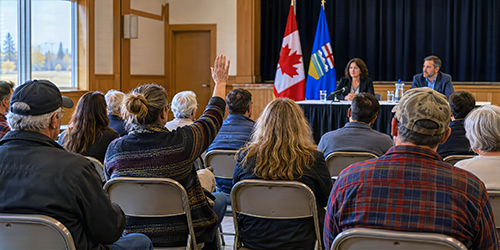
The Alberta Next consultations proceeded through town halls and online engagement. By February 2026, Smith had announced an October 19 referendum focused on immigration and Alberta’s constitutional and fiscal position within Canada. She said these subjects had emerged strongly during the panel’s work.
The question about Alberta’s future in Canada came later.
Meanwhile, public organizing had developed in opposing directions. Stay Free Alberta pursued a petition seeking independence. Former deputy premier Thomas Lukaszuk’s Alberta Forever Canada initiative sought an affirmation that Alberta remain in Canada.
The latter was a substantial campaign. Elections Alberta declared it successful, reporting 438,568 valid signatures counted and a statistically verified estimate of 404,293 signatures. That was evidence of significant mobilization in favour of Canada, rather than a public movement speaking with one separatist voice.
Treaty rights also became central. A court ruling against the separation petition prompted the Blackfoot Confederacy chiefs to emphasize that Alberta’s future involved constitutional obligations and First Nations’ relationships with the Crown. Smith disputed the ruling and announced an appeal.
On May 21, Smith announced an additional referendum question. It would ask voters to choose between remaining a Canadian province and directing the government to begin the legal process required for a future binding referendum on separation.
Smith said the competing petitions together represented approximately 700,000 signatures and justified hearing from voters. That was her argument for proceeding. It did not mean those signatories agreed about the outcome.
The October question therefore offered a choice about a further process. It was not itself a vote that could immediately take Alberta out of Canada.
Polling helps answer what the wider public wanted, although different surveys measured different things.
A Léger online survey of 1,001 Alberta adults, conducted October 2–4, found 70 per cent favoured remaining in Canada, compared with 22 per cent supporting the legal process toward another referendum. Seven per cent were undecided. Those were voting intentions, not results.
An earlier Probe Research survey addressed feelings about the referendum process itself. Among 1,484 Alberta adults surveyed April 27–May 6, 51 per cent supplied words classified as negative, while 27 per cent supplied positive descriptions.
That survey concerned the original nine-question referendum, before the national-unity question was added. It cannot be treated as a direct measurement of support for holding the final ten-question vote.
The evidence supports a careful answer. Organized groups wanted Albertans heard, and large numbers signed petitions. The provincial government selected the referendum’s timing and questions. Polling consistently showed a majority favouring Canada.
Whether people wanted the referendum held, how they intended to vote, and whether they wanted independence were separate questions. Understanding how Alberta reached October 19 requires keeping all three in view.