

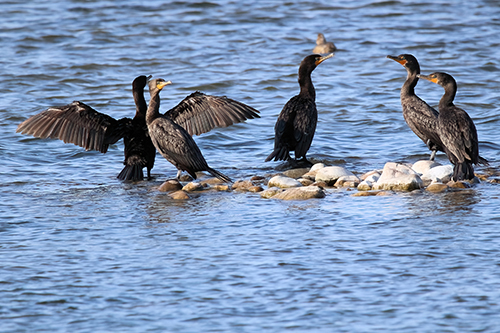
If there is one bird species that's raising a stink across the country, the honour goes to the Double-crested Cormorant. Seen at lakes and on rivers, this efficient and highly successful fish hunter receives disdain from both fishermen and those living and sharing urban locations. The dilemma for Canadians in some locations is what to do about the larger populations that exist. Is culling or reducing the population the right thing to do, or is the cormorant a key player in keeping nature in balance?
In Toronto, its islands and specifically Hanlan Point, a public docking area, is home to 18,000 cormorants. The acidic cormorant droppings are plentiful, bleaching and killing the trees in which they nest. The odor emanating from a colony, can take ones breath away. Boaters who tie up at the dock overnight, return to find their watercraft decorated in cormorant crap, resulting in fewer people using the area. Fishermen believe that cormorants have had a negative impact on sports fish populations, namely walleye. Cormorant populations at Lac La Biche have received attention in the past. In 2005, culling was implemented to complement egg oiling to rein in breeding cormorant numbers. The population dropped by 83% between 2003 and 2013.
Typically cormorants are shore nesters, but on the Toronto islands, nests can be nearly 30 metres high in the spruce trees. Methods to remove the birds have been creative. Initially during breeding season, park employees try to scare the birds into moving by yelling at them daily for an entire shift, covering the 7 week nesting period. For a few years, up to 1000 nests were knocked out of trees annually, but this ended in 2024, when a few eagles moved in to nest, requiring the area to be identified as a protected area. Of course, cormorants do read regulations, and their population exploded. Law in Toronto makes it illegal to shoot birds within city limits, hence a cull cannot be used by park authorities. Toronto also constructed a wall-less wooden structure, designed to be predator safe, calling the housing, a “corm-dominium”.
Toronto is now considering a new idea: building a bird barge, far removed from urban conflict. In the mid-1990s, the city of Hamilton built 3 islands at a cost of $2.4 million in order to “move” 40,000 nesting pairs of ring-billed gulls from the boat dock areas. Cormorants joined the gulls eventually trying to take over all three islands. Ever creative, Hamilton staff installed 5'2” tall singing Santas, all equipped with motion sensors which worked to frighten the cormorants for a while. To try and re-instill fear, an employee dressed up as a Santa, sat motionless and then tried to scare the cormorants. Well, you can imagine how that didn't work.
The good news is that is artificial islands do work. Toronto park staff ideally would like to have the entire population move to Tommy Thompson Park, where there is lots of room and the birds do nest on the ground, “Urban” cormorants certainly have Torontonians on edge.