

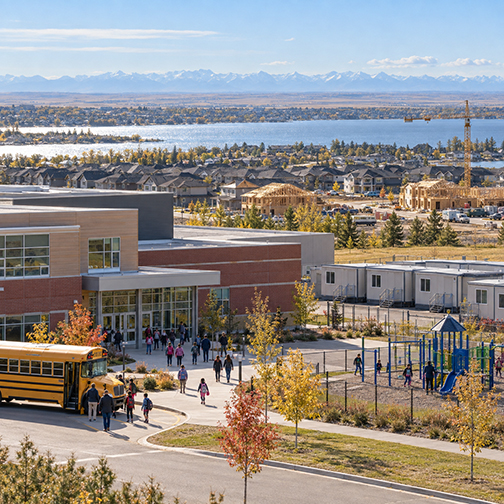
As Chestermere students settle into another school year, one question follows them through the school doors: is classroom space keeping pace with the city’s growth?
The short answer is not yet.
New schools are moving through planning and construction, modular classrooms are being added, and attendance boundaries have been adjusted. But much of that work is managing pressure rather than eliminating it. With new neighbourhoods continuing to fill, the race between home construction and school construction remains one of Chestermere’s most important growth issues.
A complete picture for the 2026–27 school year will not be available until enrolment counts are finalized later in September. Still, the recent trend is clear. Rocky View Schools now serves more than 29,600 students and expects another 4,000 students to enter the division over the next five years.
That growth arrived after local schools were already heavily used. In a January 2025 accommodation report, RVS said four of Chestermere’s five public schools were operating at full capacity as of September 2024. Overall utilization across the community was 94 per cent.
Chestermere Lake Middle School was at 100 per cent utilization and had no remaining space for additional modular classrooms, according to the RVS accommodation report.
Those numbers explain why families have seen changes that go beyond simply adding desks.
Beginning in September 2025, East Lake School expanded its English program from kindergarten to Grade 6 into a kindergarten-to-Grade-9 program. Students from several newer communities, including Chelsea, Dawson’s Landing and Waterford, were reassigned to Rainbow Creek Elementary before moving to Chestermere Lake Middle School. Other areas were directed to Prairie Waters Elementary.
The changes created space in some schools, but not evenly. Projections prepared for the accommodation decision showed East Lake could reach approximately 115 per cent utilization in 2026, while Rainbow Creek, Prairie Waters, Chestermere Lake Middle and Chestermere High were expected to remain below their rated capacities.
Those were planning projections, not confirmed 2026 enrolment figures, but they demonstrate how quickly pressure can move from one building to another.
Modular classrooms remain an important part of the response. For 2026, the province approved two new modular classrooms for Prairie Waters and two for Rainbow Creek. Rainbow Creek was also waiting for two previously approved classrooms and a relocated washroom unit.
Across Rocky View Schools, about one-third of student capacity is located in modular classrooms. The division has also reported that 68 per cent of its schools have reached their maximum modular capacity. Although modulars provide essential short-term relief, RVS acknowledges that they cannot replace permanent construction.
The most significant public-school project underway in Chestermere is the new kindergarten-to-Grade-9 school in Dawson’s Landing. The provincially funded school is planned for 905 students and is currently expected to open in fall 2028.
A new public high school in Chelsea has also advanced. The project received design funding in July 2026 after receiving planning funding the previous year. An opening date has not yet been determined, according to the latest RVS school-project update.
Chestermere’s next Catholic school is further along. Calgary Catholic’s new kindergarten-to-Grade-9 school on West Lakeview Drive is under construction and is expected to open in fall 2027. While it belongs to a separate school system, it will provide another local option and could absorb some of the community-wide demand.
The challenge is timing. A school can take years to move from a municipal site designation to a board priority, provincial approval, design, construction and opening day. During that time, homes can be completed and hundreds of children can arrive.
More projects are therefore already in the queue. RVS identified a proposed kindergarten-to-Grade-6 school in Clearwater Park as its second-highest request for the province’s 2027 capital budget. A future kindergarten-to-Grade-9 school in Bridgeport remains part of longer-term planning.
Responsibility for keeping pace is shared. The City of Chestermere identifies and protects future school sites, works with school boards during neighbourhood planning and advocates for community needs. School boards determine programs, attendance boundaries and capacity while submitting capital requests. The provincial government decides which projects receive funding and when construction can proceed.
So, are Chestermere schools keeping pace?
Teachers, administrators and school boards are finding ways to keep classrooms operating, and several long-awaited projects are moving forward. But the system is still catching up. Boundary changes and modular classrooms can provide breathing room; they cannot replace permanent schools delivered close to when neighbourhoods open.
This fall, parents should watch for finalized school-by-school enrolment numbers, installation dates for approved modulars, progress on the Dawson’s Landing construction schedule and the next funding decision for the Chelsea high school. Transportation times and future boundary changes will also reveal whether growth is being accommodated locally or simply shifted elsewhere.
Chestermere’s school story is no longer simply about building more classrooms. It is about coordinating residential development, infrastructure and provincial investment so that a new address does not automatically mean a longer bus ride or another boundary review.
The projects underway represent meaningful progress. Whether they are enough will depend on what happens before the next wave of students reaches the school doors.